
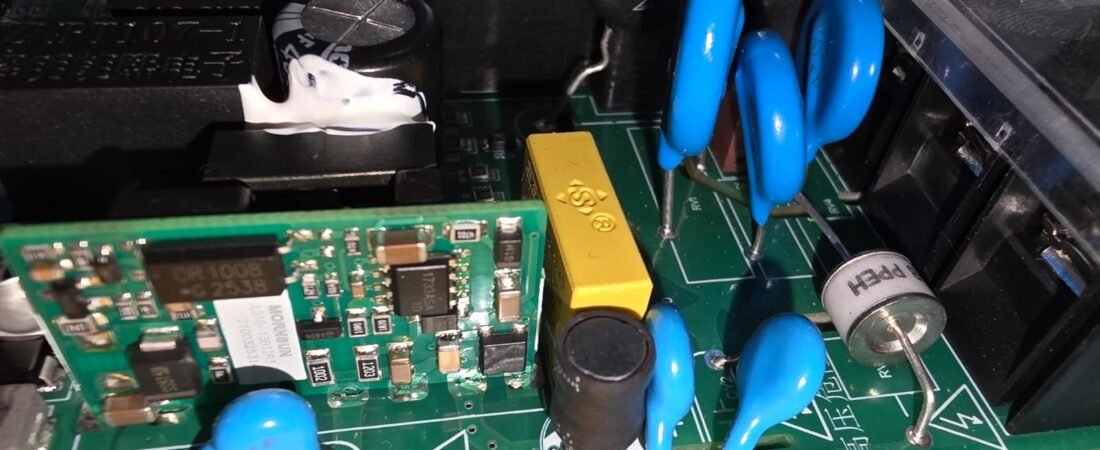
⚠️ Why Does a Y Capacitor Explode?
Y capacitors are safety-critical components used between Line/Neutral and Protective Earth (PE). They are designed to fail safely, but severe electrical or thermal stress can still cause catastrophic failure.
The main causes are:
⚡ Overvoltage / Surge
Lightning or switching transients
Voltage spikes exceeding the capacitor’s rated impulse capability
🔥 Excessive Temperature
High ambient temperature
Poor ventilation
Excessive ripple current or nearby heat sources
💥 Wrong Capacitor Type
Using a standard ceramic/film capacitor instead of a certified Class Y safety capacitor
Incorrect Y1/Y2 rating for the application
🔌 Excessive Leakage/Ripple Current
High-frequency switching currents can produce significant losses and self-heating.
🧩 Component Aging or Internal Defects
Insulation degradation
Moisture ingress
Manufacturing defects
Cracks or mechanical damage
⚠️ Incorrect Voltage Rating
A capacitor may have an adequate nominal voltage rating but still be unsuitable for the required safety/impulse environment.
🌡️ PCB/Layout Problems
Insufficient creepage and clearance
Contamination or moisture across the PCB
Poor thermal design
🔑 The important point
A properly selected and certified Y capacitor should normally fail open rather than short, because its purpose is to maintain protection against electric shock even if the capacitor fails.
So if a Y capacitor actually burns, cracks, or explodes, don’t simply replace it. Find the source of the electrical or thermal stress first.