STM32H7: A Deep Dive into STMicroelectronics’ High-Performance 32-bit Microcontroller Family
Introduction
The STM32H7 family represents one of STMicroelectronics’ most powerful microcontroller platforms, bringing performance levels traditionally associated with application processors into the world of real-time embedded systems.
Based on Arm Cortex-M7 and, in several devices, Cortex-M4 or Cortex-M7 dual-core architectures, STM32H7 microcontrollers combine high computational performance, extensive peripheral integration, advanced memory architectures, digital signal-processing capabilities, graphics acceleration, high-speed communication interfaces, and sophisticated power-management features.
The result is a family that can address applications ranging from industrial automation and motor control to electric-vehicle charging stations, robotics, instrumentation, IoT gateways, audio processing, human-machine interfaces, and sophisticated embedded control systems.
But understanding the STM32H7 family requires looking beyond the headline CPU frequency.
The real strength of STM32H7 is its architecture: multiple buses, caches, tightly coupled memories, DMA engines, high-speed peripherals, hardware accelerators, and carefully designed memory domains work together to provide both high computational throughput and deterministic real-time behavior.
1. What Is the STM32H7 Family?
STM32H7 is a family of high-performance microcontrollers belonging to STMicroelectronics’ STM32 portfolio.
The STM32 family is based on Arm Cortex-M processors and is divided into several performance classes. The H7 sits toward the high-performance end of this spectrum.
Depending on the specific device, an STM32H7 can include:
Arm Cortex-M7 CPU
Arm Cortex-M4 CPU in dual-core variants
Floating-point unit (FPU)
DSP instructions
High-performance SRAM
Flash memory
External memory interfaces
Multiple DMA controllers
High-resolution timers
Advanced motor-control timers
ADCs and DACs
Ethernet
USB
CAN FD
SPI, I²C and UART/USART
SDMMC
Camera interfaces
LCD-TFT interfaces
Chrom-ART graphics accelerator
JPEG hardware accelerator
Cryptographic acceleration
Hardware random-number generation
Security features
Advanced clock and power-management systems
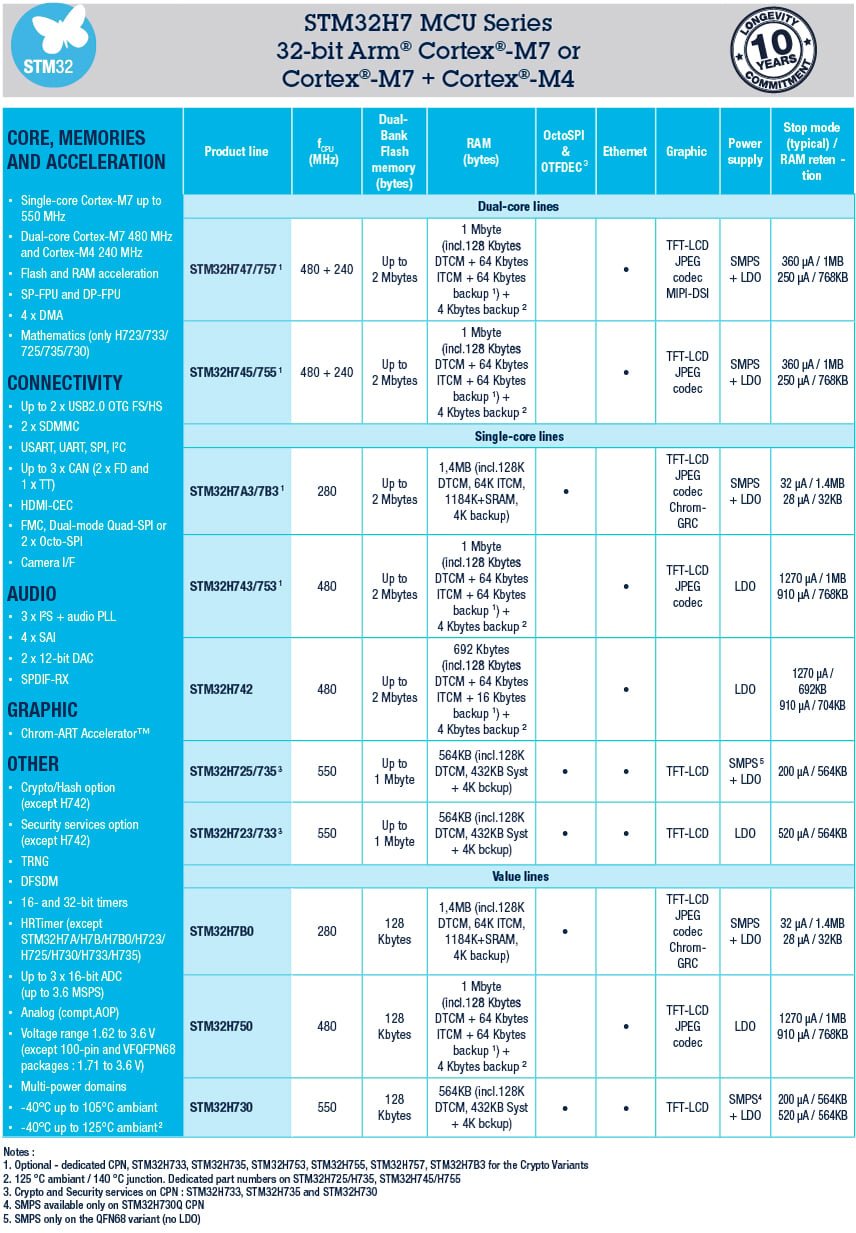
However, not every STM32H7 contains all of these features.
This is an important point when selecting an H7 device: the name “STM32H7” identifies a family, not a single microcontroller architecture with identical resources.
2. The Cortex-M7: The Heart of STM32H7
One of the defining features of STM32H7 devices is the Arm Cortex-M7 processor.
The Cortex-M7 is designed specifically for high-performance embedded applications.
Unlike a typical low-end microcontroller, the Cortex-M7 incorporates a sophisticated processor architecture capable of executing large amounts of computation while maintaining the deterministic characteristics expected from a microcontroller.
The Cortex-M7 includes:
Superscalar execution
The processor can execute more than one instruction per clock cycle under suitable conditions.
This means that CPU performance cannot be evaluated simply by looking at the clock frequency.
A 400 MHz Cortex-M7 is not simply “twice as fast” as a 200 MHz microcontroller.
The instruction mix, memory system, cache behavior, compiler optimization, and peripheral architecture all influence actual performance.
Floating-point unit
The Cortex-M7 includes floating-point hardware supporting single-precision floating-point calculations.
This is particularly useful for:
Motor-control algorithms
Digital filters
Control systems
Sensor fusion
Signal processing
Power-electronics calculations
Audio processing
Robotics
Machine-learning inference
For example, calculations involving trigonometric functions, vector transformations, PID controllers, Clarke/Park transforms, or digital filters can benefit significantly from hardware floating-point support.
3. DSP Capability
The Cortex-M7 also includes DSP-oriented instructions.
This is particularly important for embedded systems because many real-world algorithms involve repetitive mathematical operations.
Examples include:
y[n]=∑k=0N−1h[k]x[n−k]y[n] = \sum_{k=0}^{N-1} h[k]x[n-k]
which represents a finite impulse response (FIR) filter.
Instead of processing every multiplication and addition as completely independent operations, DSP-oriented instructions can significantly improve the efficiency of these calculations.
This makes the STM32H7 attractive for:
Digital signal processing
Audio
Motor control
Power converters
Predictive maintenance
Vibration analysis
Sensor processing
Communication systems
ST’s STM32 ecosystem also integrates naturally with Arm’s CMSIS-DSP library, allowing developers to use optimized DSP functions rather than implementing every mathematical algorithm from scratch.
4. Why Clock Frequency Is Not Everything
STM32H7 devices can operate at very high clock frequencies for a microcontroller.
However, simply increasing the clock frequency does not automatically produce proportional performance improvements.
The processor must be continuously supplied with instructions and data.
This creates a fundamental engineering problem:
The CPU can become faster than the memory system feeding it.
This is why the STM32H7 architecture includes features such as:
Instruction cache
Data cache
Tightly Coupled Memory
Multiple SRAM regions
Multiple bus interfaces
DMA
High-speed memory interfaces
The objective is to keep the CPU busy instead of forcing it to wait for memory.
5. The STM32H7 Memory Architecture
The memory architecture is one of the most important—and often misunderstood—parts of STM32H7.
A simple microcontroller architecture may look like:
CPU → Bus → SRAM / Flash
STM32H7 is considerably more sophisticated.
Different memory regions are connected to different parts of the internal bus architecture and may have different performance characteristics.
This means that where you place your code and data can affect system performance.
For example, an algorithm running from one memory region may behave very differently from the same algorithm running from another region.
This is especially important when using:
DMA
Ethernet
USB
LCD-TFT
Camera interfaces
SDMMC
High-speed ADC acquisition
Real-time motor-control algorithms
6. Flash Memory and Instruction Cache
Program code is normally stored in internal Flash memory.
However, Flash is slower than the CPU core.
The STM32H7 therefore uses instruction caching and an optimized memory architecture to reduce the performance penalty associated with accessing Flash.
The basic idea is straightforward:
If the CPU repeatedly executes instructions from a particular region of memory, keeping recently accessed instructions in a fast cache can greatly reduce the number of slow Flash accesses.
This becomes particularly important when executing large applications.
7. D-Cache and I-Cache: Powerful but Dangerous if Misunderstood
One of the most important concepts for STM32H7 developers is cache coherency.
The Cortex-M7 generally uses:
I-Cache for instructions
D-Cache for data
These caches can dramatically increase CPU performance.
However, DMA peripherals do not necessarily interact with memory in exactly the same way as the CPU.
Consider this situation:
The CPU writes data to a buffer.
The CPU’s cache may contain the updated data while the actual SRAM still contains older data.
A DMA controller then reads the SRAM directly.
The DMA may therefore read old data.
The opposite situation can also happen:
DMA writes new data into SRAM, but the CPU continues reading an older copy stored in its cache.
The result can be extremely confusing bugs.
For high-performance STM32H7 applications, cache management is therefore not an optional optimization—it is an important part of system design.
Developers may need to use techniques such as:
Cache clean
Cache invalidate
Non-cacheable memory regions
Memory barriers
Proper MPU configuration
Carefully allocated DMA buffers
This is one of the major differences between developing for a simple Cortex-M microcontroller and developing for a high-performance Cortex-M7 system.
8. Tightly Coupled Memory
Another important feature of Cortex-M7-based STM32 devices is Tightly Coupled Memory, commonly known as TCM.
TCM provides very fast memory access directly associated with the processor.
It is particularly useful for code and data that require predictable execution.
For example, a real-time control algorithm can benefit from placing critical routines and variables into appropriate TCM regions.
This can be particularly valuable in:
Motor control
Digital power supplies
EV chargers
Inverters
Robotics
Industrial control
The goal is not simply maximum average performance.
In control systems, predictable execution time can be just as important as raw computational performance.
9. DMA: Let the Peripherals Work Without the CPU
A powerful CPU should not spend its time copying bytes from one memory location to another.
This is where Direct Memory Access becomes extremely important.
DMA allows peripherals to transfer data directly between peripherals and memory with minimal CPU intervention.
For example:
ADC → DMA → SRAM
Instead of:
ADC → CPU → SRAM
For a high-speed ADC acquisition system, DMA can continuously fill a buffer while the CPU performs calculations on another part of the buffer.
This creates a powerful architecture:
Peripheral acquisition → DMA → memory buffer → CPU processing
This approach is fundamental to high-performance embedded systems.
10. Double Buffering
A common technique in STM32H7 applications is double buffering.
Imagine an ADC continuously sampling a signal.
A DMA controller fills:
Buffer A
while the CPU processes:
Buffer B
When Buffer A is full, the roles are exchanged.
This allows data acquisition and processing to happen simultaneously.
The concept is:
ADC
 │
 ▼
DMA
 │
 ├── Buffer A → CPU processing
 │
 └── Buffer B → DMA acquisition
This architecture is extremely useful for:
Power-quality measurement
Audio processing
Oscilloscopes
Motor-control systems
Vibration monitoring
Digital filters
Energy meters
11. Dual-Core STM32H7 Devices
Some STM32H7 devices use a dual-core architecture.
A typical configuration combines:
Cortex-M7 + Cortex-M4
The idea is not simply to obtain two CPUs.
The two cores can be assigned different responsibilities.
For example:
Cortex-M7
High-performance tasks:
Graphics
Networking
Complex algorithms
Signal processing
Application logic
Cortex-M4
Real-time or auxiliary tasks:
Sensor acquisition
Motor-control loops
Communication handling
Background processing
Safety monitoring
This architecture can provide a powerful separation between computationally intensive software and deterministic real-time tasks.
12. STM32H7 and Real-Time Control
One of the strongest applications for STM32H7 is power electronics.
Consider an EV charger.
The microcontroller may need to simultaneously perform:
AC voltage measurement
AC current measurement
Power calculation
Power-factor calculation
Control-loop execution
PWM generation
Protection monitoring
Temperature monitoring
Communication
Display management
Ethernet or CAN communication
RFID/NFC interaction
OCPP-related communication through an external system
A conventional low-end MCU can quickly become overloaded.
The STM32H7 provides enough computational performance and peripheral capability to integrate many of these functions into a single controller architecture.
13. Timers: One of the Hidden Strengths
The STM32H7 family contains an extensive timer system.
Timers are not simply used for generating delays.
They can implement:
PWM
Input capture
Output compare
Encoder interfaces
Trigger generation
Synchronization
One-pulse operation
Motor-control waveforms
Advanced timers are particularly important for power electronics.
For example, a three-phase inverter may require complementary PWM signals with carefully controlled dead time.
The timer hardware can generate these waveforms independently of the CPU.
This is much safer and more deterministic than attempting to toggle GPIO pins through software.
14. ADCs and Digital Power Electronics
High-performance ADCs are another important feature of STM32H7 devices.
In power electronics, ADC performance directly affects the quality of the control system.
Consider a current-control loop.
The system may perform:
Current measurement
ADC conversion
Digital filtering
Error calculation
PI controller
PWM update
This entire process may need to happen within a very small time interval.
The STM32H7 architecture provides the computational and peripheral resources required to implement sophisticated digital control systems.
15. Communication Interfaces
STM32H7 devices provide an extensive collection of communication interfaces.
Depending on the specific device, these can include:
UART / USART
Used for:
Debugging
GPS
Bluetooth modules
Modems
Industrial devices
SPI
Useful for:
Displays
ADCs
DACs
Flash memory
Sensors
RF transceivers
I²C
Commonly used for:
Sensors
EEPROM
Power-management ICs
RTCs
Configuration devices
CAN / CAN FD
Extremely important for:
Automotive systems
EV chargers
Battery systems
Industrial automation
Motor controllers
Ethernet
Some STM32H7 devices provide Ethernet MAC functionality.
This opens the door to:
TCP/IP
Web interfaces
Industrial Ethernet
MQTT
Modbus TCP
Networked instrumentation
IoT gateways
16. USB
USB is another major capability of the STM32H7 family.
Depending on the device, USB functionality can support applications such as:
USB device
USB host
Virtual COM port
Mass storage
HID
Custom USB devices
This allows an STM32H7-based product to communicate directly with computers and other USB devices.
17. Graphics and Human-Machine Interfaces
Some STM32H7 devices are designed to handle sophisticated graphical interfaces.
Hardware accelerators can reduce the CPU workload associated with graphics operations.
Features available on selected devices can include:
LCD-TFT controllers
Chrom-ART graphics accelerator
JPEG accelerator
External memory interfaces
This allows developers to build sophisticated embedded displays without necessarily requiring a Linux-based application processor.
For industrial equipment, instrumentation, laboratory equipment, and EV charging stations, this can be extremely attractive.
18. External Memory
One of the major advantages of the higher-end STM32H7 devices is the ability to interface with external memory.
Depending on the device, external memory interfaces can support technologies such as:
SDRAM
NOR Flash
NAND Flash
PSRAM
Quad-SPI Flash
Octo-SPI memory
This becomes important when an application requires large graphical assets, buffers, data logging, or external program memory.
For example, a graphical user interface may require considerably more memory than a simple control application.
19. Security
Modern embedded products increasingly require hardware-assisted security.
STM32H7 devices provide various security mechanisms depending on the specific family member.
These can include:
Secure boot mechanisms
Cryptographic accelerators
Random-number generation
Hardware key management
Memory protection
Debug protection
Secure firmware update mechanisms
Security is particularly important for connected products.
An EV charger connected to a network, for example, should not be treated simply as a power converter.
It is also a networked computer connected to potentially sensitive infrastructure.
20. STM32Cube Ecosystem
One of the reasons STM32H7 is widely used is not only the hardware.
STMicroelectronics provides a complete software ecosystem around STM32 devices.
A typical development environment may involve:
STM32CubeMX
for configuring:
Clocks
GPIO
Timers
ADC
DMA
Communication peripherals
Middleware
Memory
followed by development in:
STM32CubeIDE
or another supported IDE/toolchain.
The STM32Cube ecosystem can also provide middleware for technologies such as:
USB
TCP/IP
File systems
RTOS
Graphics
Networking
This significantly reduces development time.
21. STM32H7 and FreeRTOS
For complex applications, bare-metal programming can eventually become difficult to maintain.
A Real-Time Operating System such as FreeRTOS allows the application to be divided into independent tasks.
For example:
Task 1 → Measurement
Task 2 → Control
Task 3 → Communication
Task 4 → Display
Task 5 → Data logging
Task 6 → Diagnostics
The RTOS scheduler manages execution while interrupts handle time-critical events.
However, an RTOS should not replace good architectural design.
A poorly designed RTOS application can still suffer from:
Priority inversion
Race conditions
Excessive context switching
Memory fragmentation
Timing problems
Cache/DMA coherency issues
The STM32H7 gives developers tremendous capability, but it also requires greater architectural discipline.
22. STM32H7 PCB Design Considerations
The performance of the microcontroller is only useful if the PCB is designed correctly.
High-performance STM32H7 designs require careful attention to:
Power distribution
Multiple supply domains may exist.
Decoupling capacitors should be placed close to the relevant power pins.
The goal is to minimize:
Supply impedance
High-frequency noise
Ground bounce
Voltage fluctuations
Grounding
A continuous, low-impedance ground system is essential.
High-current switching paths should be carefully separated from sensitive analog measurement paths.
This is especially important in power-electronics applications.
Clock design
The crystal or oscillator circuit should be placed close to the MCU.
Clock traces should be kept short and routed carefully.
High-speed interfaces
USB, Ethernet, SDRAM, Octo-SPI and other high-speed interfaces require controlled routing and appropriate PCB stack-up considerations.
Thermal design
Although STM32H7 devices are microcontrollers, high CPU utilization and high clock frequencies can produce significant thermal dissipation.
Thermal performance should therefore be considered in high-load applications.
23. STM32H7 Versus STM32F4
A natural question is:
Why use STM32H7 instead of STM32F4?
The answer depends on the application.
STM32F4 devices are still excellent microcontrollers.
However, STM32H7 generally provides substantially greater:
CPU performance
Memory bandwidth
Peripheral capability
DSP performance
Graphics capability
Communication capability
External-memory support
If the application is a simple sensor node, STM32H7 may be unnecessary.
But if the application requires:
High-speed signal processing
Advanced motor control
Ethernet
Complex graphics
Large data buffers
Multiple simultaneous communication interfaces
Sophisticated control algorithms
then STM32H7 becomes much more attractive.
24. STM32H7 Versus an Application Processor
An STM32H7 can also occupy an interesting position between a conventional microcontroller and a Linux-based processor.
An application processor may provide significantly more computing power, but it often introduces:
Operating-system complexity
Longer boot times
Higher power consumption
More complicated hardware
Greater software complexity
STM32H7 retains the advantages of the microcontroller world:
Fast startup + real-time operation + deterministic peripherals + low power + integrated hardware
while providing considerably more computational capability than traditional MCUs.
25. The Importance of Choosing the Correct H7
One of the biggest mistakes when selecting an STM32H7 is assuming that all H7 devices are equivalent.
They are not.
The STM32H7 family contains multiple subfamilies and device variants with different:
CPU configurations
Maximum frequencies
Flash sizes
SRAM sizes
Package options
ADC configurations
Timers
Communication peripherals
Graphics capabilities
Security features
External-memory interfaces
Therefore, the correct selection process should begin with the application requirements.
For example:
Need high-performance control?
Look at Cortex-M7 performance, timers, ADCs and DMA.
Need graphics?
Look for LCD-TFT, Chrom-ART, JPEG and external-memory capabilities.
Need networking?
Check Ethernet, USB and available communication peripherals.
Need dual-core operation?
Select an appropriate Cortex-M7/Cortex-M4 device.
Need large memory?
Evaluate internal Flash/SRAM and external-memory interfaces.
26. STM32H7 Is Powerful—but Complexity Comes With It
The biggest advantage of STM32H7 is also one of its biggest challenges.
There are many features.
That means there are many configuration possibilities.
Developers must understand:
Clock trees
Bus architecture
Memory regions
Cache
MPU
DMA
Interrupt priorities
Peripheral clocks
Power domains
RTOS behavior
Linker scripts
Memory alignment
Cache coherency
A program that works perfectly on a simple Cortex-M4 may fail unexpectedly when moved to Cortex-M7 because the memory system is fundamentally more sophisticated.
The lesson is important:
STM32H7 should not be treated as simply a faster STM32F4.
It is a different class of microcontroller architecture.
27. The Right Way to Learn STM32H7
For engineers beginning with STM32H7, learning everything simultaneously is unnecessary.
A better progression is:
Level 1 — MCU fundamentals
Understand:
GPIO
UART
SPI
I²C
Timers
Interrupts
Level 2 — STM32 architecture
Learn:
Clock tree
Bus architecture
Memory map
DMA
NVIC
Level 3 — Cortex-M7
Study:
Cache
MPU
TCM
FPU
DSP instructions
Level 4 — Advanced peripherals
Move to:
ADC + DMA
PWM
Ethernet
USB
CAN FD
SDMMC
Level 5 — Real-time architecture
Then introduce:
FreeRTOS
Task scheduling
Interrupt design
Inter-task communication
Memory management
Level 6 — Application development
Finally integrate everything into a real system such as:
Motor controller
Solar inverter
EV charger
Industrial controller
IoT gateway
Data acquisition system
Conclusion
The STM32H7 family represents a significant evolution of the traditional microcontroller.
Its value is not simply the high CPU clock frequency.
The real strength comes from the combination of a high-performance Cortex-M7 processor, floating-point and DSP capabilities, sophisticated memory architecture, cache, TCM, DMA, advanced timers, high-speed ADCs, communication peripherals, graphics capabilities, security features and an extensive software ecosystem.
For simple embedded applications, an STM32H7 may be excessive.
For demanding real-time applications, however, it can provide an impressive balance between computational performance and microcontroller-level determinism.
For engineers working in areas such as power electronics, renewable energy, motor control, robotics, industrial automation, instrumentation and EV charging, the STM32H7 family deserves particular attention.
The most important lesson is this:
Do not select an STM32H7 simply because it is fast. Select it because its architecture allows the CPU, memory, DMA and peripherals to work together as a high-performance real-time system.
That architectural understanding is what turns the STM32H7 from a powerful microcontroller into a powerful engineering platform.